

- Reaction score
- 1,938
A novel phase of matter has been achieved by a team of American researchers, finally realizing a theoretical quantum prediction using nanoscale building blocks, a breakthrough that could pave the way for room-temperature quantum computing.
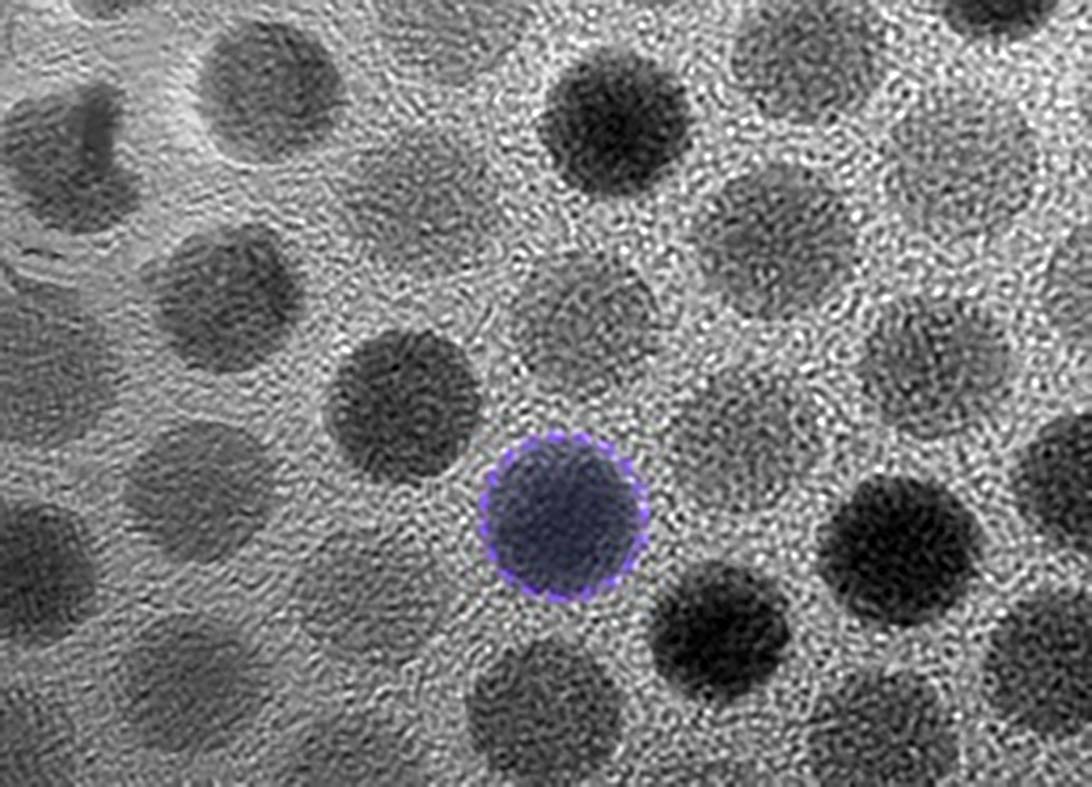
Researchers at Brown University and the University of Michigan College of Engineering revealed how they briefly stabilized the novel state of matter in a nanoparticle superlattice in a recent paper published in the journal Science. They say their work provides a new method for engineering classes of materials with custom-shaped nanoparticles, which could be applied to quantum computers and other quantum applications.
“Our work is a little bit like kids playing with LEGO blocks,” said co-author Ou Chen, an associate professor of chemistry at Brown. “We synthesize unique nanoscale building blocks and stack them into interesting structures. In this case, we were able to stabilize these theorized transitional structures and demonstrate important quantum optical properties.”
Most metals form in one of two primary groups of crystal structures. The first is face-centered cubic (FCC), the tightest packing arrangement for spherical particles, typically forming a cube with a single particle at each corner and at the center of each face. The other type is body-centered cubic (BCC), a more loosely packed structure in which single particles are still present at the corners, but instead of each face being centered on a particle, one sits at the center of the entire arrangement.
 thedebrief.org
Researchers at Brown University and the University of Michigan College of Engineering revealed how they briefly stabilized the novel state of matter in a nanoparticle superlattice in a recent paper published in the journal Science. They say their work provides a new method for engineering classes of materials with custom-shaped nanoparticles, which could be applied to quantum computers and other quantum applications.
“Our work is a little bit like kids playing with LEGO blocks,” said co-author Ou Chen, an associate professor of chemistry at Brown. “We synthesize unique nanoscale building blocks and stack them into interesting structures. In this case, we were able to stabilize these theorized transitional structures and demonstrate important quantum optical properties.”
Most metals form in one of two primary groups of crystal structures. The first is face-centered cubic (FCC), the tightest packing arrangement for spherical particles, typically forming a cube with a single particle at each corner and at the center of each face. The other type is body-centered cubic (BCC), a more loosely packed structure in which single particles are still present at the corners, but instead of each face being centered on a particle, one sits at the center of the entire arrangement.
Room-Temperature Quantum Computing? A Superlattice Breakthrough Could Be Poised to Help Supercharge Information Science
A novel phase of matter has been achieved by researchers, finally realizing a theoretical quantum prediction using nanoscale building blocks.
thedebrief.org


