

- Reaction score
- 2,276
We've tested gaming performance with Nvidia's new 'Nvidia App,' which is installed by default with the driver package, and found that it reduces performance by up to 15% in some games.
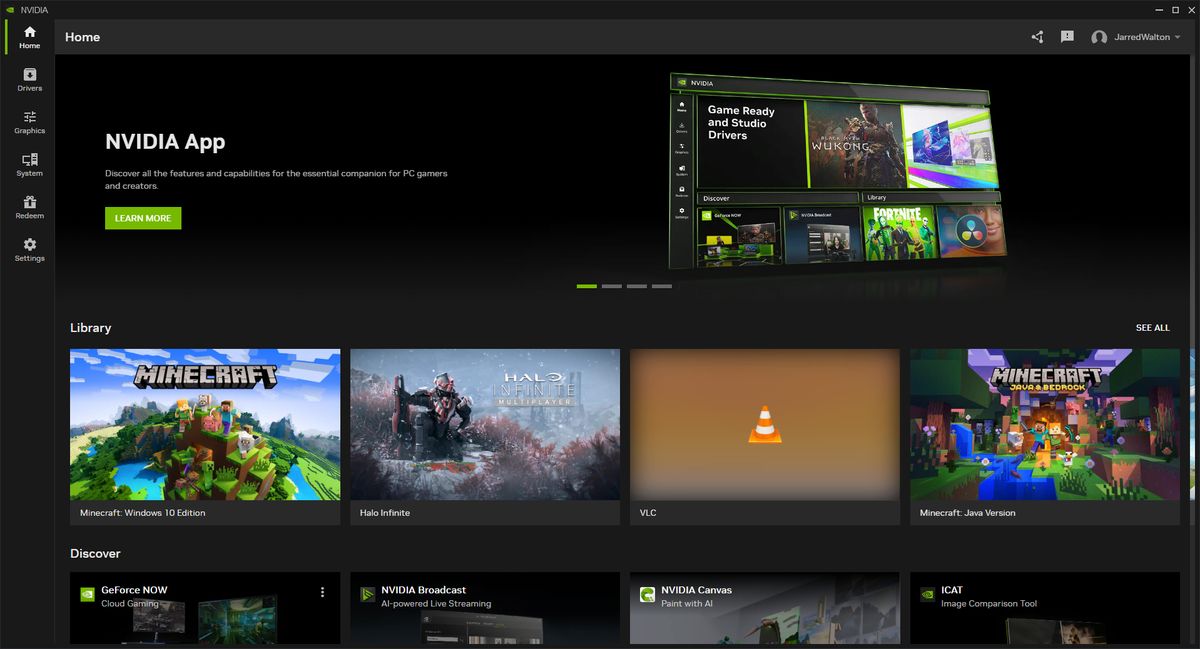
When Nvidia rolled out its 566.14 drivers last month, it officially placed GeForce Experience (GFE) on legacy status. The first time you load GFE with 566.14, it will prompt you to update to the new Nvidia App. You could decline, but there will be no future updates to GFE. With the 566.36 drivers, Nvidia removed GFE completely and there's only the Nvidia App — or you can run without the extra features it provides and install the drivers only. It appears skipping the Nvidia App might be the better course of action for the time being, as we've confirmed reports around the web that the App hurts gaming performance, dropping framerates by up to 15% in some cases.
If it's not immediately clear, 15% is a massive performance drop caused by a driver or application update. To put it in perspective, the more expensive RTX 4060 Ti is only 18% faster than the base model RTX 4060, according to our GPU benchmarks, running both at 1080p medium settings. Thankfully, the performance decrease isn't universally 15%, but we tested with the 4060 and saw a 2–12 percent drop in framerates across the five games that we tested.
We used the numbers from our recent Intel Arc B580 review, then retested a handful of games after doing a clean driver install, this time without installing the Nvidia App as part of the package. The Nvidia App was initially running with the default settings (i.e., overlay enabled, but not actively using it). Here's the rundown of performance.
Everywhere else, not having the Nvidia App installed (or at least not running, though we didn't check that scenario) improved performance. We sort of expected 1080p medium to show the largest delta, as that's more of a CPU-limited scenario, but the performance hit was mostly independent of the settings and resolutions we tested. Some games showed a smaller hit to performance, others larger, and of course we're only talking about one set of hardware tested for the time being. But it's clear there's a problem with performance being reduced by a not-insignificant amount.
 www.tomshardware.com
This article needs more investigation.
When Nvidia rolled out its 566.14 drivers last month, it officially placed GeForce Experience (GFE) on legacy status. The first time you load GFE with 566.14, it will prompt you to update to the new Nvidia App. You could decline, but there will be no future updates to GFE. With the 566.36 drivers, Nvidia removed GFE completely and there's only the Nvidia App — or you can run without the extra features it provides and install the drivers only. It appears skipping the Nvidia App might be the better course of action for the time being, as we've confirmed reports around the web that the App hurts gaming performance, dropping framerates by up to 15% in some cases.
If it's not immediately clear, 15% is a massive performance drop caused by a driver or application update. To put it in perspective, the more expensive RTX 4060 Ti is only 18% faster than the base model RTX 4060, according to our GPU benchmarks, running both at 1080p medium settings. Thankfully, the performance decrease isn't universally 15%, but we tested with the 4060 and saw a 2–12 percent drop in framerates across the five games that we tested.
We used the numbers from our recent Intel Arc B580 review, then retested a handful of games after doing a clean driver install, this time without installing the Nvidia App as part of the package. The Nvidia App was initially running with the default settings (i.e., overlay enabled, but not actively using it). Here's the rundown of performance.
Everywhere else, not having the Nvidia App installed (or at least not running, though we didn't check that scenario) improved performance. We sort of expected 1080p medium to show the largest delta, as that's more of a CPU-limited scenario, but the performance hit was mostly independent of the settings and resolutions we tested. Some games showed a smaller hit to performance, others larger, and of course we're only talking about one set of hardware tested for the time being. But it's clear there's a problem with performance being reduced by a not-insignificant amount.
We tested the Nvidia App performance problems — games can run up to 15 percent slower with the app
Maybe it should have stayed in beta a while longer?
This article needs more investigation.


